Scientific Clarification

The Dating Revolution

In 1988, headlines declared the Shroud a medieval forgery. Decades of subsequent peer-reviewed chemistry revealed that the test was fatally compromised—while cutting-edge X-ray crystallography has now restored the Shroud to the 1st century.

WAXS Synchrotron X-Ray Analysis of Flax Cellulose Aging
Italian National Research Council (CNR)
The 2022 Discovery

Wide-Angle X-Ray Scattering (WAXS)

Measuring Natural Aging at the Sub-Nanometer Scale

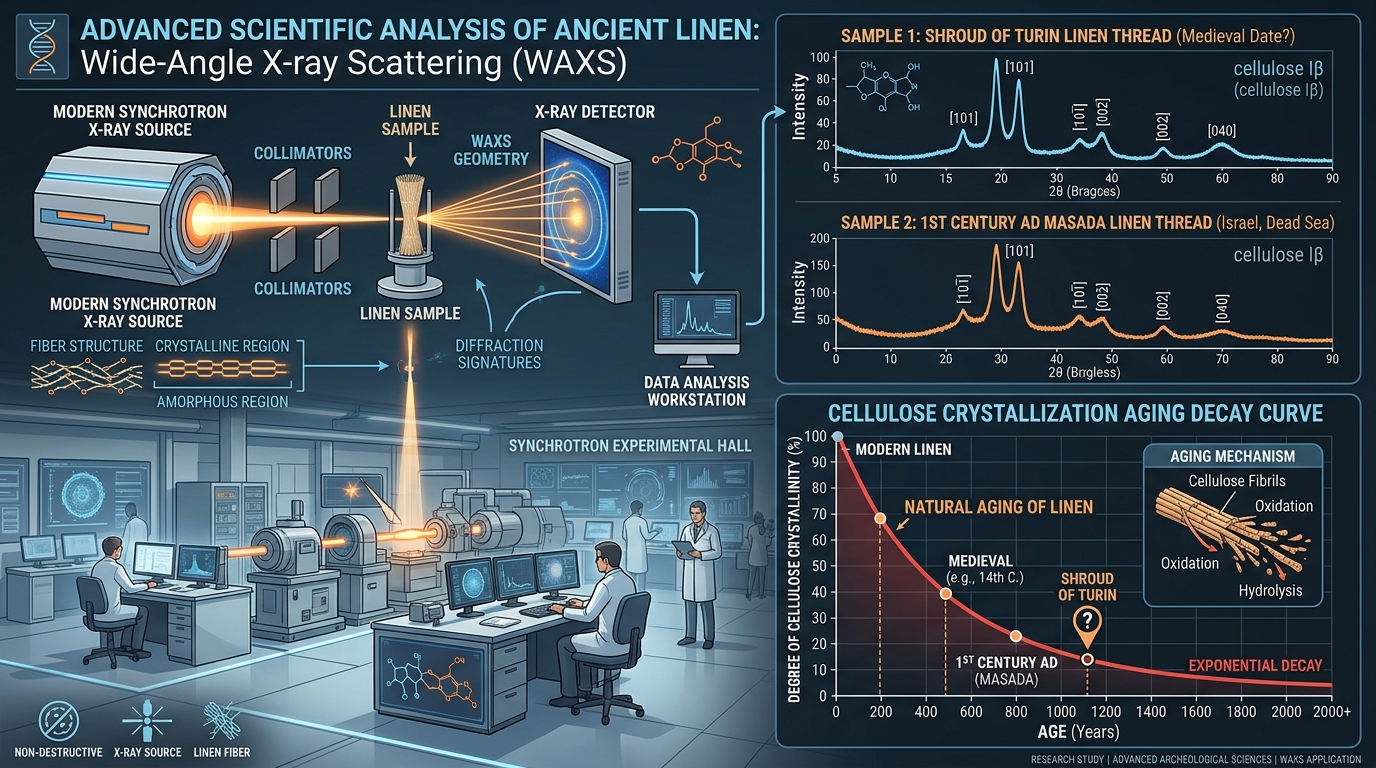
In April 2022, a team of physicists led by Dr. Liberato De Caro at the Institute of Crystallography of the Italian National Research Council (CNR) published groundbreaking research in the peer-reviewed journal Heritage.

Unlike radiocarbon dating, which is vulnerable to surface carbon contamination, smoke, and reweaves, WAXS measures the natural structural degradation of the cellulose polymer chains within flax fibers over time.

  • Rigorous Calibration: Tested against documented historical linens spanning 3000 BC to the present day.
  • The Masada Match: The cellulose degradation profile of the Shroud matched ancient linen samples excavated from the fortress of Masada, Israel (dated to 55–74 AD).
  • Direct Conclusion: The Shroud's structural aging is completely consistent with an age of approximately 2,000 years, completely refuting the medieval hypothesis.
The Flawed Test

Why the 1988 C-14 Test Was Invalid

The 1988 radiocarbon test is often cited by skeptics who are unaware of what happened in the laboratory over the following 30 years.

Violation of Protocol

The Single Sample Fatal Flaw

The original scientific protocol mandated taking samples from multiple distinct locations across the cloth. At the last minute, authorities altered the protocol and cut a single strip from the most heavily contaminated edge: the Raes corner.

Chemical Anomaly

The 16th-Century French Reweave

In 2000, researchers Sue Benford and Joseph Marino identified photographic evidence of an invisible reweave. In 2005, Los Alamos chemist Dr. Raymond Rogers confirmed that the 1988 sample contained cotton fibers dyed with gum-madder root—materials completely absent from the rest of the Shroud.

Statistical Failure

2019 Release of Hidden Raw Data

For 30 years, the British Museum withheld raw laboratory data. When a Freedom of Information legal request forced its release in 2019, statistician Tristan Casabianca proved that the results from the three labs were statistically heterogeneous—meaning the sample was not uniform and the date was scientifically meaningless.

Peer-Reviewed Chemistry

Dr. Raymond Rogers & Thermochimica Acta (2005)

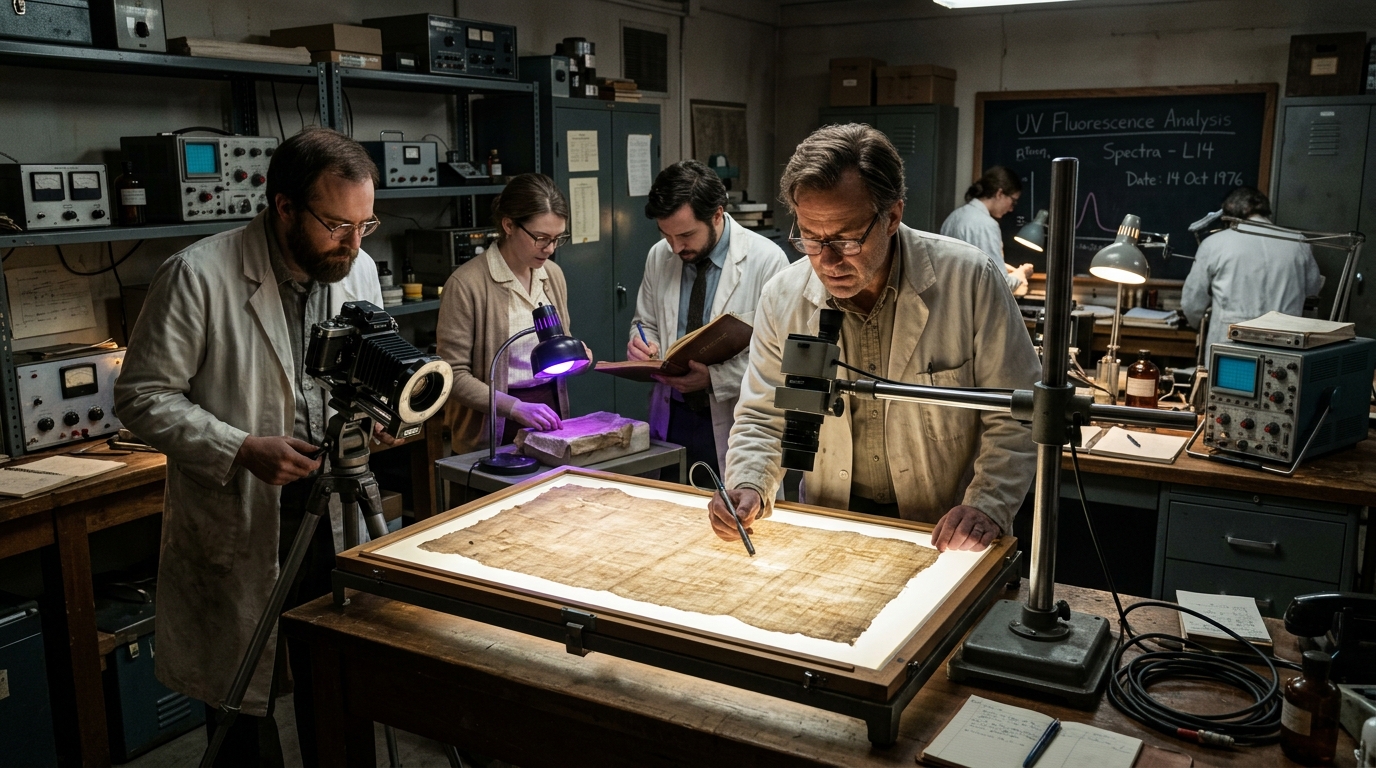
Dr. Raymond N. Rogers was a Fellow of the Los Alamos National Laboratory and STURP's Director of Chemical Research. When he first heard the "reweave theory," he set out to disprove it, believing it to be wishful thinking.

Rogers obtained authentic reserve threads from the actual 1988 C-14 cutting, certified by STURP and church custodian Prof. Luigi Gonella. When he placed them under the microscope and conducted chemical pyrolization mass spectrometry:

"The radiocarbon sample has completely different chemical properties than the main body of the Shroud... The sample used to date the Shroud was a mix of original linen and dyed cotton, invisibly spliced during a 16th-century repair."

— Dr. Raymond N. Rogers, Los Alamos National Laboratory

His findings were peer-reviewed and published in Thermochimica Acta (Vol. 425, pp. 189–194), establishing beyond scientific doubt that the 1988 sample was chemically invalid.

STURP Chemical Laboratory Testing of Shroud Threads
1978–2005 Research
Multi-Method Confirmation

Alternative Modern Dating Methods

WAXS is not the only modern scientific method that points to antiquity. Multiple independent tests align on the 1st century:

University of Padua

Mechanical Tensile & Rupture Testing

Prof. Giulio Fanti, professor of mechanical and thermal measurements at the University of Padua, subjected Shroud sub-microscopic fibers to mechanical tensile and fracture tests. The mechanical loss of elasticity correlated with ancient linens from the 1st century BC to 2nd century AD.

Infrared Spectroscopy

FT-IR & Raman Spectroscopy

Fourier-Transform Infrared (FT-IR) and Raman vibrational spectroscopy measure the organic bond decay in cellulose fibers. Calibrated against ancient archaeological textiles, these non-destructive optical tests dated the Shroud linen to 300 BC ± 400 years and 200 BC ± 500 years.