
 YouTube
 Facebook
 X/Twitter
 Podcast RSS
 Instagram
 TikTok
Is the value of π (pi) encoded in the Bible? Is it even possible? Let's walk through it one step at a time, starting with a verse that skeptics love to quote.
It is the glory of God to conceal a thing: but the honour of kings is to search out a matter.
🔎 Step 1 — The Verse Everyone Argues About
He made the Sea of cast metal, circular in shape, measuring ten cubits from rim to rim and five cubits high. It took a line of thirty cubits to measure around it.
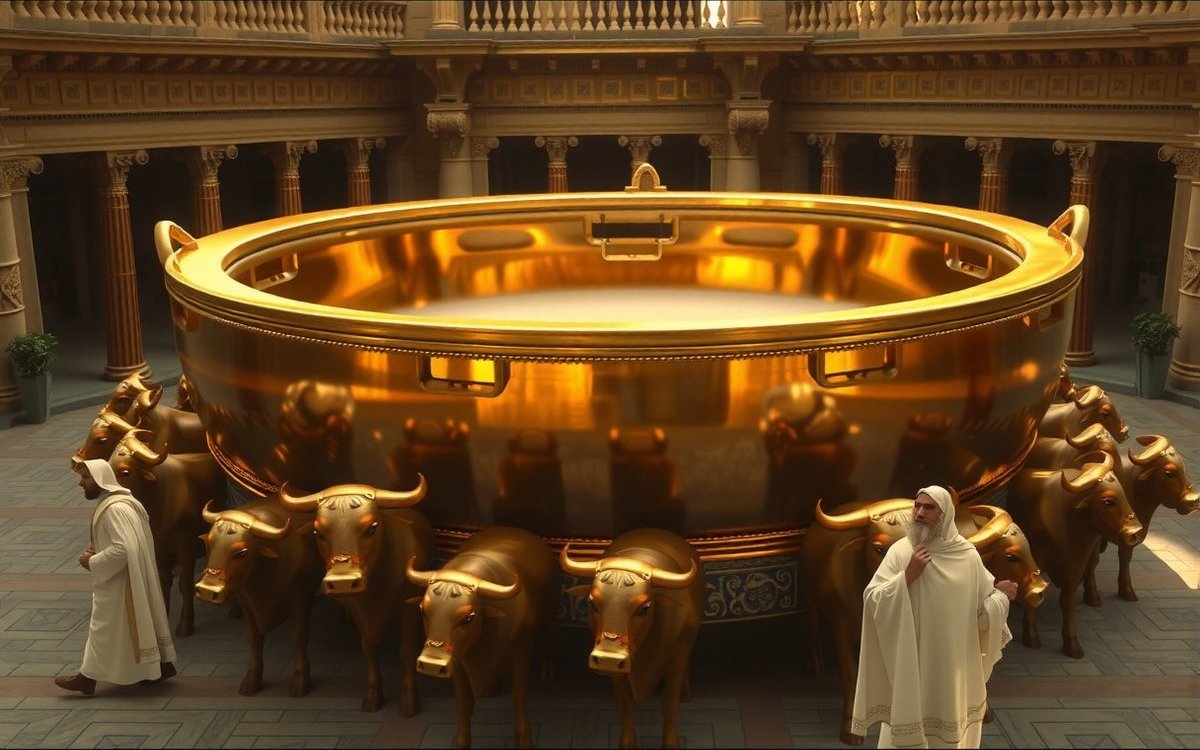
The verse describes a huge round bronze basin: 10 cubits across (its diameter) and 30 cubits around (its circumference). Almost any schoolchild can spot the problem. The circumference of a circle is the diameter multiplied by π:
Circumference = Diameter × π = 10 × 3.14159… = 31.4159 cubits
10cubits across
30cubits around (as written)
31.42cubits around (true value)
⚠️ The skeptic's objection
Many present this as an "error" in the Old Testament and a rebuttal to the inerrancy of Scripture.
How can the Bible be inerrant when it contains such an obvious geometric mistake? How do we deal with this?
✍️ Step 2 — A Strange "Spelling Error"
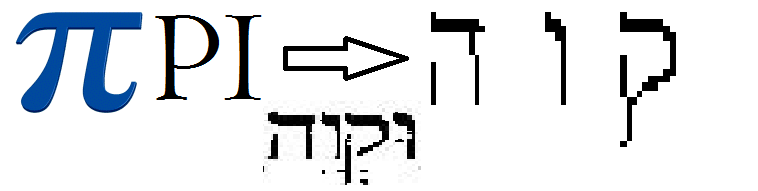
Look closely at the Hebrew. The normal word for a measuring line (circumference) is qav — קו. But in this verse the word is written qaveh — קוה, with an extra letter heh (ה) on the end.
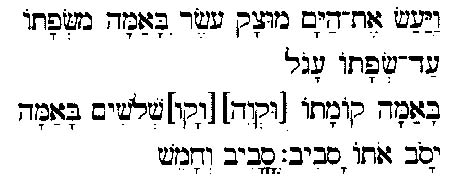
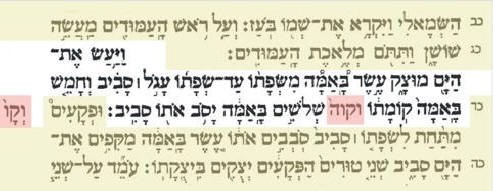
So we have a word that is spelled "wrong" and a measurement that is "wrong". One might conclude the author of this verse was simply incompetent. But notice something important about how the Hebrew Bible was copied:
ℹ️ The scribes never altered the text
Jewish scribes never changed a letter of Scripture, even when they believed a word had been copied incorrectly or misspelled.
Instead they wrote what they thought it should say in the margin (the Qere, "what is read", beside the
Kethib, "what is written"). To the ancient scribes an oddity like this was also a remez — a hint of
something deeper. That is the clue: treat the odd spelling not as an error but as a mathematical formula.

🔢 Step 3 — Hebrew Letters Are Also Numbers
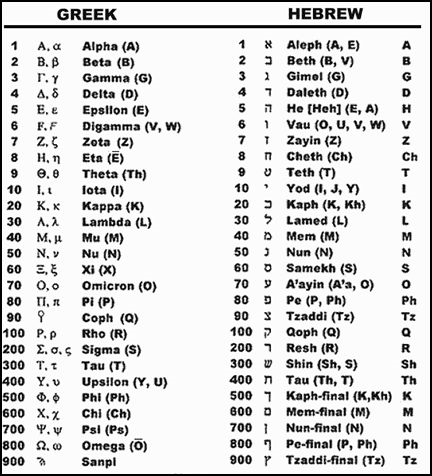
The Hebrew alphabet is alphanumeric: every letter also has a numeric value and can be used as a number (this is called gematria). Here are the values of the letters involved:
| Letter | Name | Value |
|---|---|---|
| ק | qof | 100 |
| ו | vav | 6 |
| ה | heh | 5 |
Normal spelling — קו qav
100 + 6 = 106
As written here — קוה qaveh
100 + 6 + 5 = 111
The unusual spelling changes the word's value from 106 to 111. In other words, the word for "circumference" has been adjusted by the ratio 111 ⁄ 106 (= 1.047169811…).
✅ Step 4 — Apply the Same Ratio to the Measurement
Now apply that same adjustment (111 ⁄ 106) to the stated circumference of 30 cubits:
- Stated circumference30 cubits
- Multiply by the spelling ratio30 × 111 ⁄ 106
- Hidden circumference31.41509434 cubits
- True circumference (10 × π)31.41592654 cubits
🎯 The result
The hidden value of π is 3.14151 against the true 3.14159 — a difference of only
0.0000832, or 0.0026 %. On a basin 30 cubits (about 45 feet) around, that is an error of
roughly 15 thousandths of an inch. That can't possibly be a coincidence.
| Approximation of π | Value | Error |
|---|---|---|
| Bible read literally (30 ÷ 10) | 3.00000 | 4.5 % |
| School estimate 22 ⁄ 7 | 3.14286 | 0.040 % |
| Hidden in the spelling: 3 × 111 ⁄ 106 | 3.14151 | 0.0026 % |
| True value | 3.14159… | — |
This value of π is 15 times more accurate than the 22 ⁄ 7 estimate we learned in school. How could any human author have placed it there? Such precision far exceeds the measuring instruments of Solomon's day, and the ancient world did not reach it until roughly a thousand years later. How was it encoded into the text? By God, using an uncommon spelling "error"? Yes.
🧪 Try It Yourself — Circumference Calculator
Compare the literal reading, the hidden reading, and the true value.
30.00× 3 (literal)
× 3 × 111 ⁄ 106 (hidden)
31.4159× π (true)
🌌 The Secret of the Universe in the First Verse
Interestingly, the value of π also appears in the very first verse of the Bible:
In the beginning God created the heavens and the earth.
בְּרֵאשִׁית בָּרָא אֱלֹהִים אֵת הַשָּׁמַיִם וְאֵת הָאָרֶץ

How? Take the numeric value of every letter and of every word, and apply this formula:
(number of letters) × (product of the letter values)(number of words) × (product of the word values)
= 3.1416 × 10¹⁷
This is too coincidental to be ignored. And when you apply the very same formula to the first verse of John's Gospel you get the other great mathematical constant, e (see below). You can check both with the calculator further down this page.
I pondered this for a while. Why would God put the value of π in the very first verse of the Bible? Why would it be so important for the very first verse? I have been fascinated with π all my life — I even memorized it as a kid — and always suspected it was hidden in Scripture.
💡 π is not just a value — it is a concept
Then I realized something startling about π. It is not just a number; it is a concept. π shows up whenever a lower dimension is encapsulated by a higher dimension.
So what does all this mean? The first verse mentions two things: the Heavens and the Earth — a higher dimension and a lower dimension. Another way of looking at it: the Heavens (the spiritual world) and the Earth (the physical world of time and space). This would indicate that the physical world is an encapsulated dimension inside the spiritual world.
An encapsulated dimension is a very different idea from the competing beliefs of "parallel dimensions" or "multi-dimensions". The closest concept we have for it is something like Virtual Reality or a Digital Simulation.
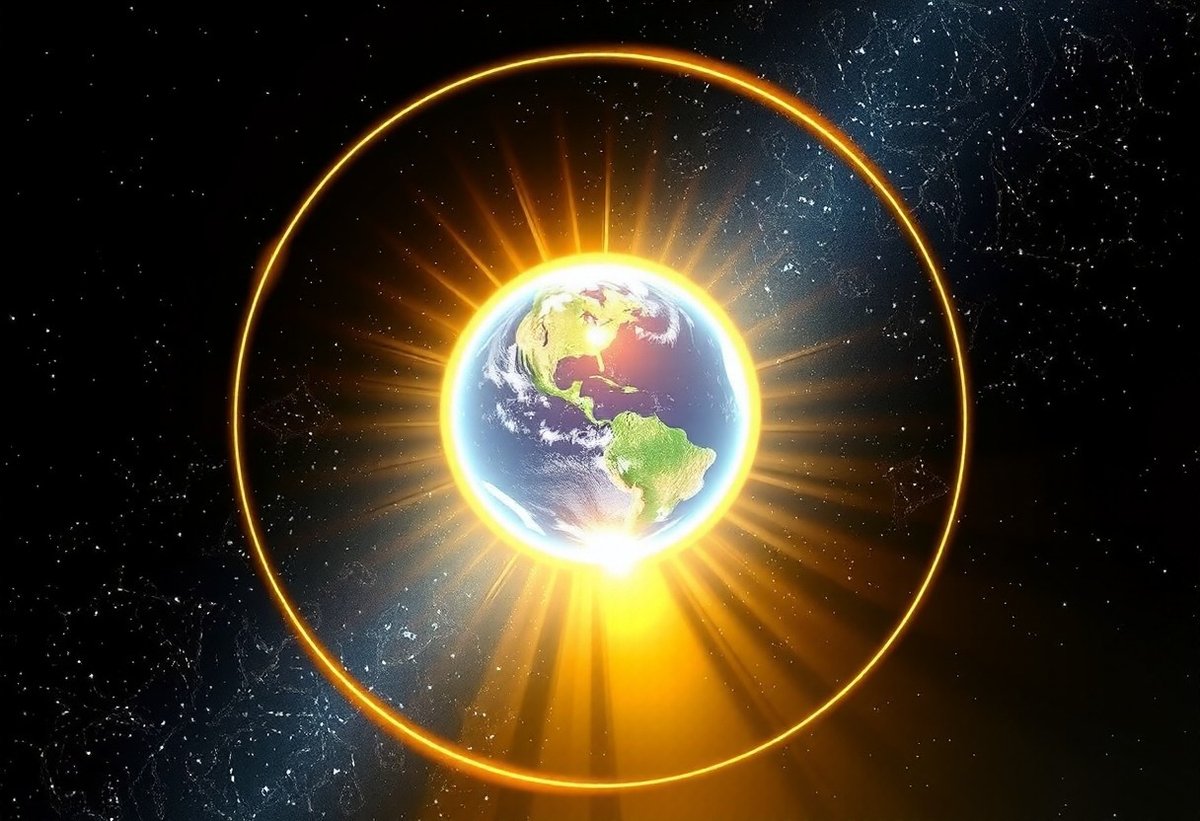
🌠 Time and Space is a virtual world encapsulated by the spiritual world
This is an amazing discovery. The secret of the universe is hidden in the first verse of the Bible — and it would help explain
some of the confounding scientific findings about the limitations of our universe
(see here).
✍️ Author's note
I, Robert B. Brownell, made this discovery in July 2014 and wrote this article on October 22, 2014, after reading
www.khouse.org/articles/2003/482/.
✝️ The Secret of Jesus in the First Verse of John
In the beginning was the Word, and the Word was with God, and the Word was God.
Ἐν ἀρχῇ ἦν ὁ λόγος, καὶ ὁ λόγος ἦν πρὸς τὸν θεόν, καὶ θεὸς ἦν ὁ λόγος.
Why would the value of e (2.71828…, Euler's number) be hidden in the first verse of John — using the same formula, and the same sentence structure as Genesis 1:1? Why would it be so important for God to put it there?
(number of letters) × (product of the letter values)(number of words) × (product of the word values)
= 2.7183 × 1040
Then I realized that, just like π, e is not a value — it is a concept. e is the number we use when a formula has higher powers (exponentials) and we need to bring those higher powers down so we can manage and deal with them. We really cannot handle a formula's higher powers without e.
✨ That is the very concept of John 1:1
Jehovah is a higher power that we cannot manage or deal with — too perfect, too holy, too high, too glorious, too far out of
reach for sinful man. But now He has sent His Word: a higher power that comes down, so that we can approach
and deal with a perfect and holy God, which was once impossible.
The secret of Jesus is hidden in the first verse of John: e.
🧮 Verse Gematria Calculator
Paste any verse in Hebrew or Greek (or choose a preset) to see its letter values and its unique number from the formula used above. Vowel points, accents and punctuation are ignored; the Greek iota-subscript counts as the letter iota.
0words
0letters
0sum of all letters
—unique number
| # | Word | Letters → values | Word value |
|---|
Show the full numbers
- Product of the letter values
- Product of the word values
- Formula
- (letters × product of letters) ÷ (words × product of words)
📌 In Summary
π in the Molten Sea
The odd spelling קוה adjusts 30 cubits by 111 ⁄ 106 and yields π to 4 decimal places — 15× better than 22 ⁄ 7.
π in Genesis 1:1
The letter-and-word formula on the first verse of the Bible gives 3.1416 × 10¹⁷. The physical world is encapsulated by the spiritual.
e in John 1:1
The same formula on the first verse of John gives 2.7183 × 1040. The Word brings the unreachable higher power down to us.
📚 Sources & Further Reading
- Koinonia House — "The Value of Pi" (source article for the 111 ⁄ 106 discovery)
- Koinonia House — π and e in Genesis 1:1 and John 1:1 (with chart)
- Koinonia House — the limits of our universe
- BibleHub Hebrew 6957 — qav (קו), a measuring line
- BibleHub Hebrew 6961 — qaveh (קוה)
- Math Goodies — circumference of a circle