Chapter Nine - The Leader
As we were walking, William drew me aside so that we would be far enough from the others that no one would hear us. Something was bothering him. He seemed compelled to talk about it as we walked in the morning sun.
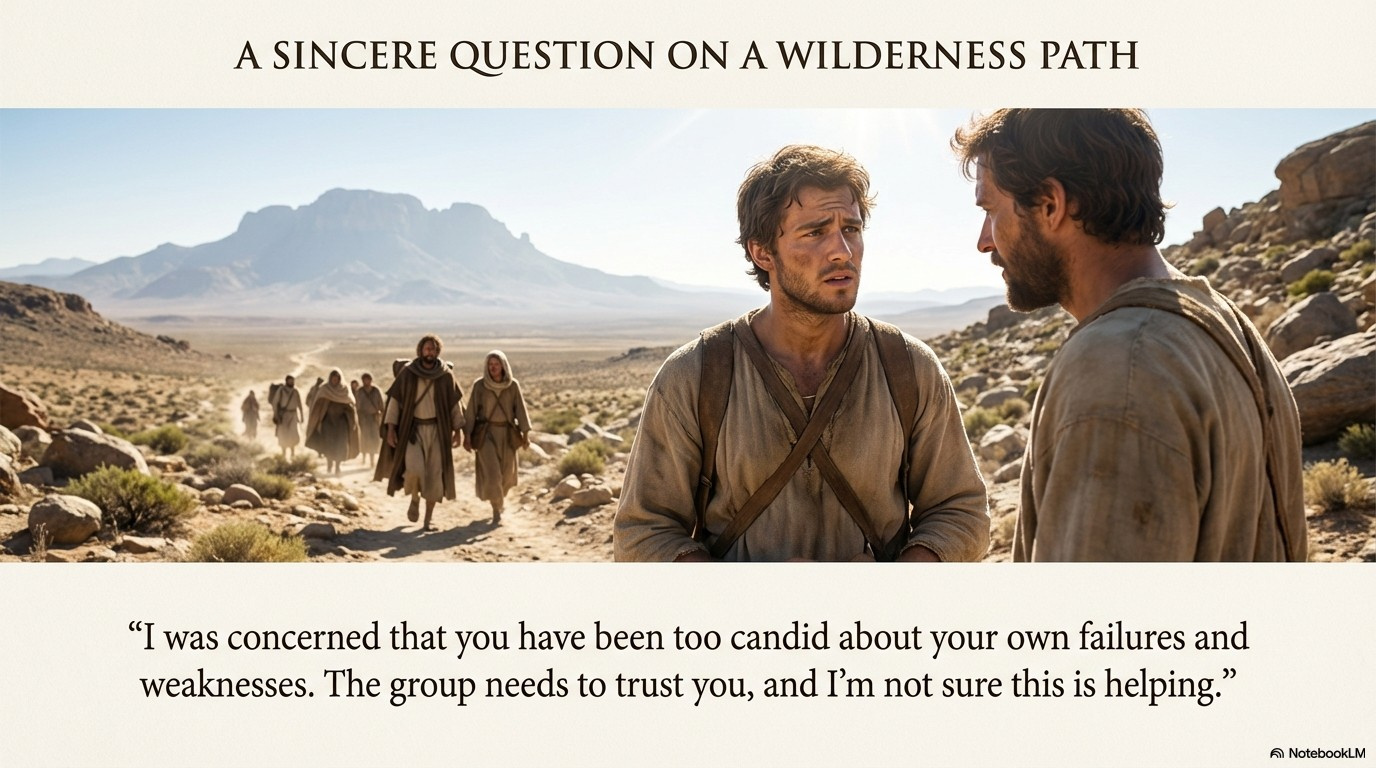
“I’ve been watching how you handle this group,” William began. “This is a unique situation, and I am interested in understanding your methods.” “I appreciate your interest, and I would very much like to hear your insights,” I replied. “I was concerned that you have been too candid about your own failures and weaknesses. The group needs to trust you, and I’m not sure this is helping. However, I have to admit I could tell that this did cause some to trust you even more, maybe because of your transparency. Is that what you were trying to achieve?” “It may have worked out that way, but I did not do it for that reason,” I replied. “My reason for being transparent is because I was given a job to do—to get this group through this wilderness. They will only make it by their faith in God, not me. I know there is a certain trust they must have in me as God’s provision for them at this time, but my goal is to get them to the place where they do not need me. I want to get them there as fast as I can. I want them to make it, even if I do not make it.” “That is a remarkably selfless way to think,” William responded. “It may not be as selfless as it seems,” I explained. “If I fail but they succeed, then I have still accomplished something, and my efforts will not have been in vain. I have had great teachers myself. Some of them finished well, and some did not, but I know that the fruit that I bear will still go to their account because of all that they invested in me. So I want to accomplish all that I can for their sakes as well, especially the ones whose lives seemingly ended in failure. They can still succeed through me if I do. “I am grateful for those who sowed into my life even if they did not finish well, but I confess that I am also doing this for selfish reasons. As I said earlier, the only commandment with a promise is to honor our fathers and mothers. The promise is that it may go well with us, and we would have longevity. I want to honor them because I do care for them, but also because I have learned the great benefit we receive for doing this.” “Your candor is appreciated but, again, I wonder if it is helpful to be so transparent with everyone,” William replied. “You may be right. I might not be so candid with immature or unstable ones, but these are different. I cannot treat these as followers, but as co-laborers. Any one of these could mature here much faster than I have and deserve this position of leadership more than me. If so, I want to make that transition as smoothly and as quickly as possible.” “I have never heard any leader talk like that,” William replied. “William, my goal here is not leadership. I did not ask for this position nor want it. This is an assignment that I am honored to have, but it is a duty. My purpose is to grow in Christ like everyone else here. Did He not lay down His life and give His leadership to others? I want to be the best leader that I can be for His sake and their sakes. My purpose is not to be the leader, but getting them through this wilderness. I will quickly defer to anyone that can do a better job at this than me with, of course, the approval of the One who is the Leader of us all. Sometimes the greatest leadership can be to know when to give up the leadership and follow.
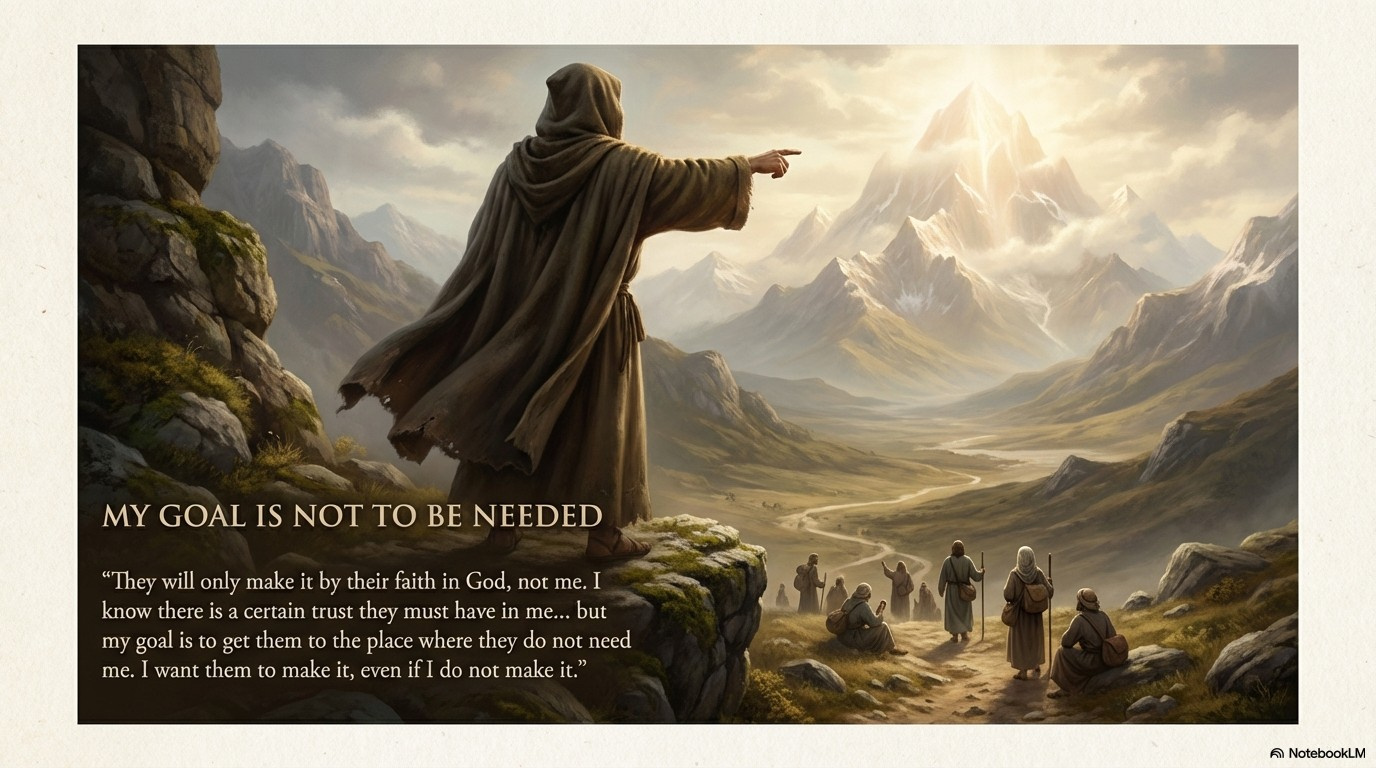
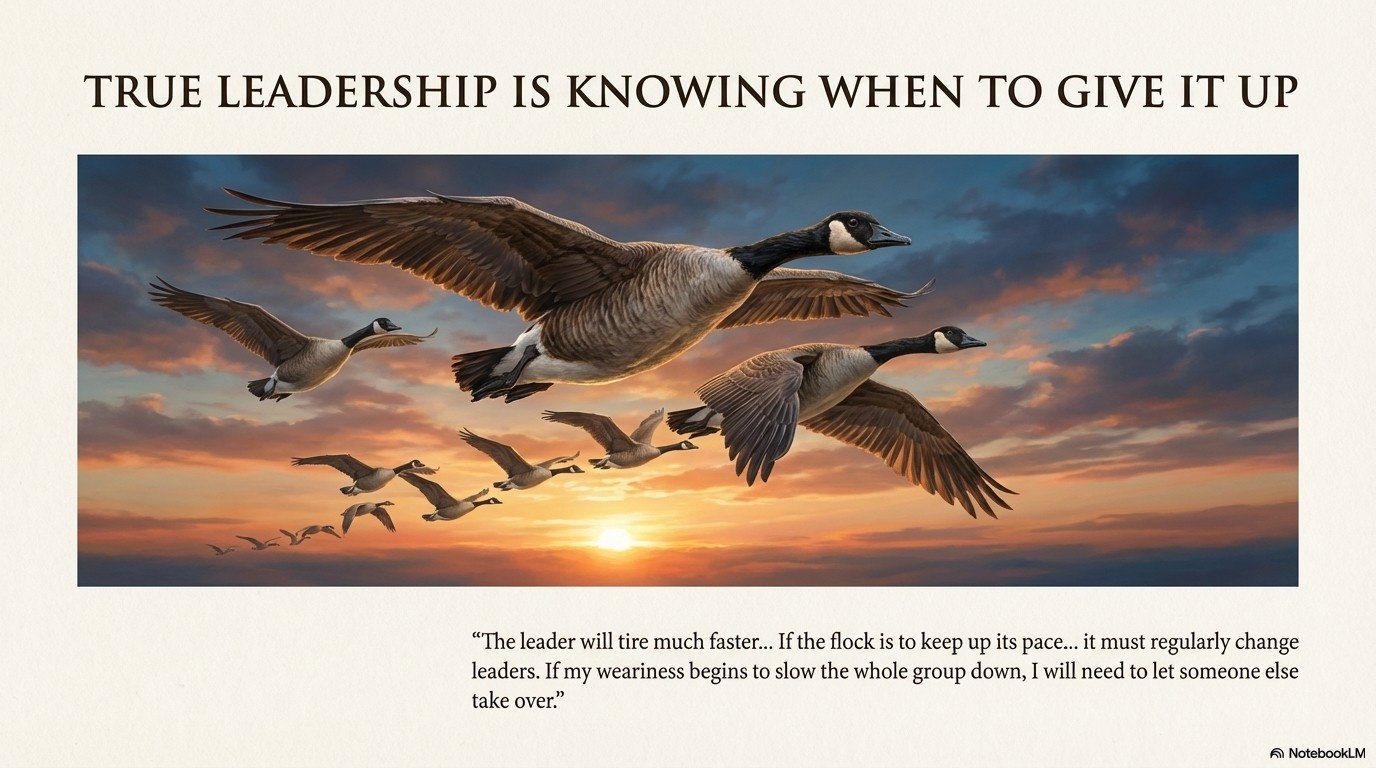
“A long time ago, I was told that the leadership that would get us to our destination was modeled by geese. They fly in a V formation behind the leader, because it is about 30% easier to draft behind others than it is to be in the lead. Therefore, the leader will tire much faster than those behind. If the flock is to keep up its pace, getting as far as it can as quickly as it can, it must regularly change leaders. If my weariness begins to slow the whole group down, I will need to let someone else take over, at least for a while, until the same thing happens to them. I am already looking for who might be next so I can help prepare them for it.”
“It makes great sense, but I have never heard anything like this before from anyone in leadership,” William replied. “Here things are different than in the world. To be a leader is a very shallow goal. Getting to the mountain with all who have been entrusted to us is the goal. I do not want to let anything, even my own place, eclipse that purpose.” “Are you thinking that I might be one of those called to lead for a time?” William asked. “Yes.” I replied. “But I am a new believer, younger than any of the others here. Doesn’t The Bible warn against giving leadership to new believers?” “It does. I am mindful of that too. However, maturity in Christ is not just the result of the passage of time. It is much more the result of how we deal with the trials we are given. It is the result of being humble enough to be teachable, but even more than this, it is the result of getting close to the King and learning from Him. “I have spent my life seeking to know the Teacher. He is the One who told me that to make it through this place I had to put the interests of all others above my own. The right answer to every crisis or problem is to put the interests of others first. In one sense you could say that I am doing this selfishly to get through this by putting their interests above mine. It is in their best interest to get to the place as fast as possible where they could make it without me if they needed to.” “I know selfishness and selfish ambition very well from my experience. With everyone I worked with, it was all about them. If this is what is driving you, then you are hiding it very well,” William remarked. “Again, thank you. It is encouraging for you to say that because I often feel like the most selfish person I know. I honestly do not know if I am just able to hide it well. Even so, I do know this: so many in these times gave their lives to Christ, but were then taught to follow people, movements, or certain doctrines, and were never led to Him. At best, this always leads to disappointment and a shallow, frustrating life far from the abundant life they were promised. There is only one foundation that we can build upon, and that is Christ Himself. I really did not mean to share anything for the purpose of getting people to trust me more or less, but to turn them to the only One who will never fail them or disappoint them.” “I believe you’re sincere in this, but I’ve just never seen this approach to leadership. I have not been in Christ for very long, and this is a very different approach than I have ever seen. Even on the ship, it was all about the leaders. They were mainly devoted to getting people to trust in them and follow them. I often felt the same kind of selfishness and self-centeredness that I felt in the political leaders I’ve served and just assumed that was normal. Even the visiting speakers all seemed to be doing the same thing, trying to get people to trust in them as God’s man or woman of the hour. Is this the general practice of the church, or was their stream an exception?” William asked.
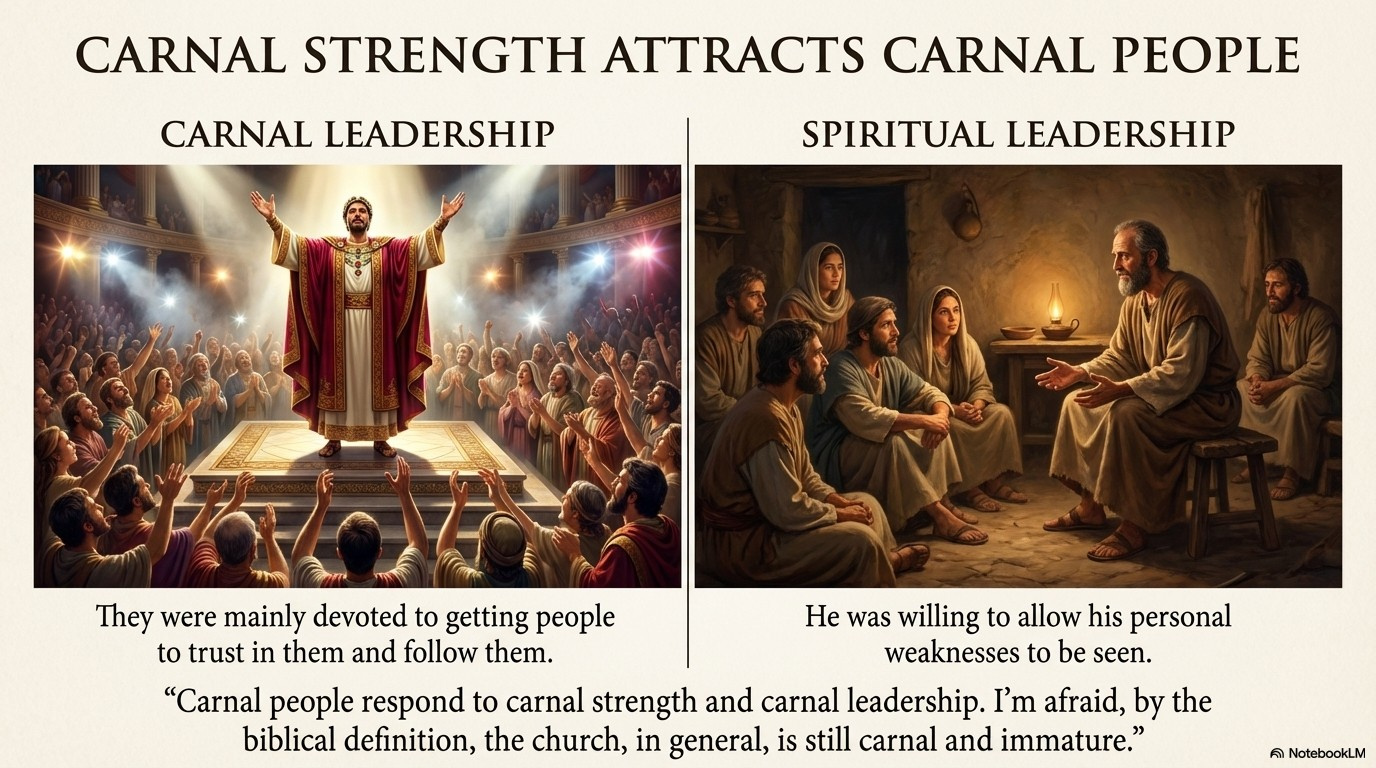
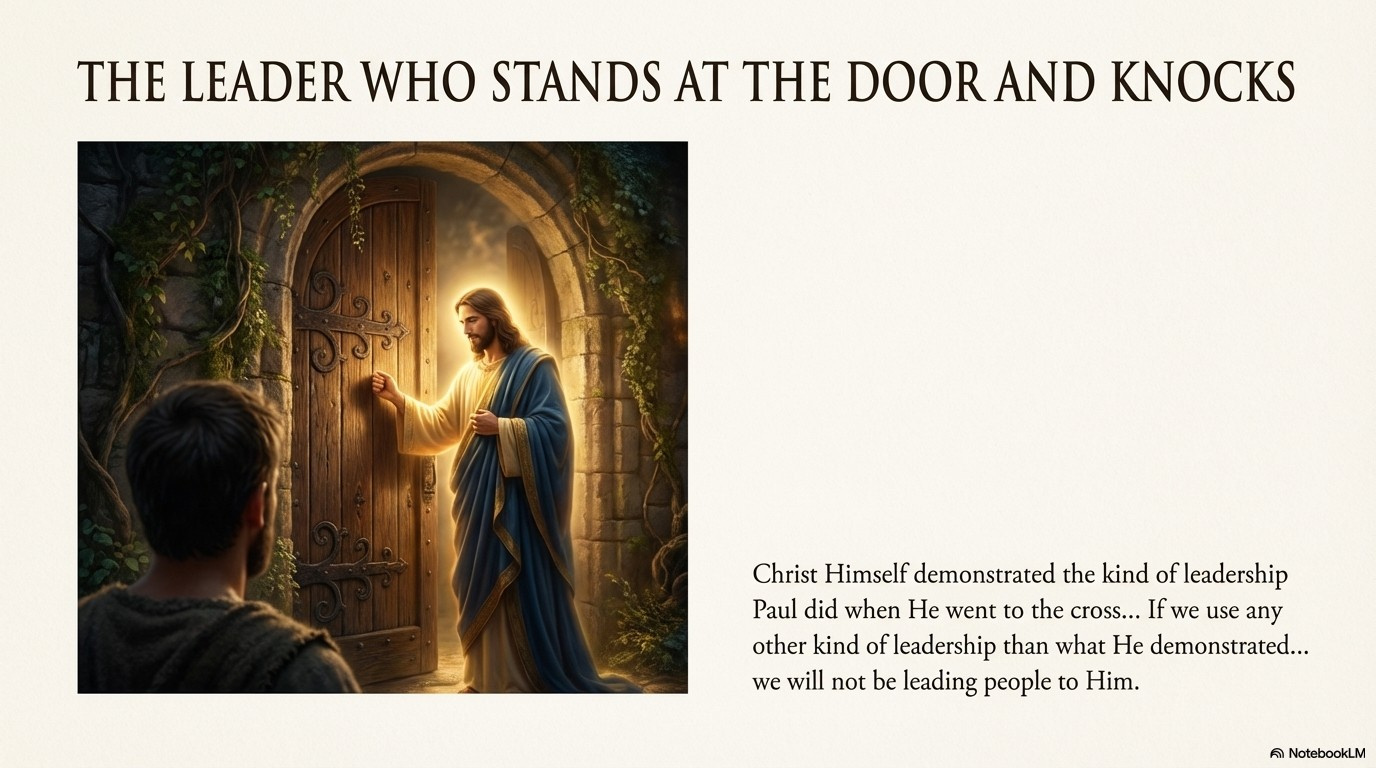
“My experience with that particular stream is limited, and I would not want to base my judgment on such a brief experience with them,” I answered. “I have been to many streams and movements in the body of Christ, maybe even most of them. I have found treasures and strengths in all of them. Even so, I think the kind of leadership taught and demonstrated by the Lord and the early apostles is rarely found today. Those who demonstrate it all have very small ministries by today’s standards. However, you can always tell a big difference in how much more mature and how much closer to the Lord those under their leadership are. “The Apostle Paul lamented that the Corinthians would follow those who abused them and even slapped them in the face. But Paul came allowing his personal weaknesses to be seen, and they would not listen to him. Carnal people respond to carnal strength and carnal leadership. I’m afraid, by the biblical definition, the church, in general, is still carnal and immature. Do you think Paul should have changed his style of leadership so that the Corinthians would be more prone to listen to him?” I asked. William did not immediately answer, but thought about this deeply before responding. This was impressive to me and so was his answer when he finally gave it: “Christ Himself demonstrated the kind of leadership Paul did when He went to the cross. In Revelation 3, He stands outside the door of His own church knocking to see if any will open to Him. He does not force Himself on us. If we use any other kind of leadership than what He demonstrated, which is what I think Paul also used, we will not be leading people to Him,” William said. “There are not many who can see this,” I responded. “Of those who see it not many actually walk in it. It is much easier to use carnal leadership to motivate carnal people than it is to help them mature. I pray that you will walk in the way of this great insight that you already have. “Our goal must not be to just get people to do the right thing, but to get them to follow the King and to do the right thing because it is in their hearts. You can teach a parrot to say the right thing and do the right thing, but it will not be in its heart. God is seeking to give us a new heart and a new mind so that we obey Him from a true heart, not just out of compulsion.
“I know the traps and diversions ahead of us. The further we get, the more just having truth will not be enough to keep us. We must have more than truth; we must have a love for the truth to make it. Only with this love for the truth will we choose the right path when there are options. Only by following our love for God and His people will we avoid the traps. “The Truth is a person that we must love above all else. Only this love will keep us close to Him, and only by staying close to Him will we be able to make it. We must get so close to Him that we are following Him, not just principles.” “I think you are doing the right thing by being as transparent as you are,” William admitted. “Now I see why Paul wrote that he would rather glory in his weaknesses. He wanted the Corinthians to trust in the grace of God, not him. There is a place for honoring our spiritual fathers and mothers, and Paul was their spiritual father, but he was not afraid to come in weakness and fear so that the grace of God could be even more evident. This compelled them to build their faith on God, not him. This is a very different kind of leadership.”

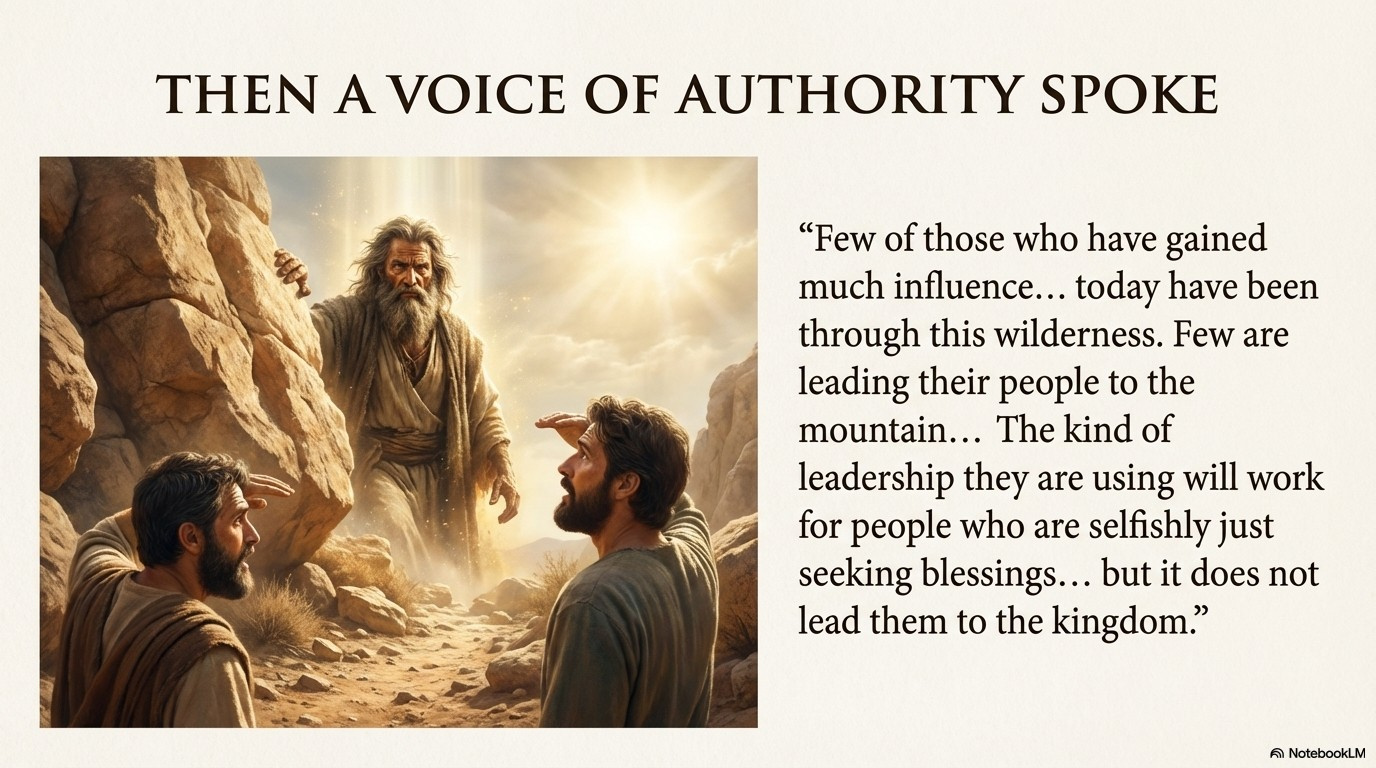
“William, I have met very few who grasp the things that you already understand,” I responded. “Life is all about Jesus. If we stay close to Him, we will be changed by Him. Then we will begin to see with His eyes, hear with His ears, and understand with His heart. The way to fulfilling our purpose is to follow Him. He is The Way. To lead them through this wilderness, I must lead them to Him. There is no other way. I will fail, and we will all fail, if we do not find Him and follow Him.” “Again, my experience in the faith is limited, but as this is the kind of leadership that both the Lord and His apostles taught and demonstrated, why do we not see more of this kind of leadership in the church?” William asked again. “There are a number of reasons. One is that many have reduced The Great Commission to making converts instead of disciples. When our vision is so shallow, then we can only impart such shallowness to those we lead. “We are told that the Holy Spirit searches the depths, even the depths of God. No follower of Christ who has the Holy Spirit should ever be shallow in anything, much less their knowledge of God and His ways. This shallowness always results in many spiritual shipwrecks, and I think the shepherds may end up taking a lot of responsibility for these.” “Another reason for this shallowness is that few of those who have gained much influence in the body of Christ today have been through this wilderness. Few are leading their people to the mountain,” Elijah responded, who had been listening nearby without being noticed. He continued: “The kind of leadership they are using will work for people who are selfishly just seeking blessings and abundance for themselves, but it does not lead them to the kingdom. Selfishness will get you killed on the path that leads to the kingdom. It is only by being willing to lose our lives for the King and His people that you will find true life and stay alive here. The blessings of the Lord are to be received and appreciated, but when they become your focus and purpose, you will not make it to the mountain of the Lord. Neither will you be prepared for the great battle that is coming. “Please continue,” he said, nodding to me. “Some of the greatest leaders in church history may be alive in our time,” I said, looking at Elijah to see if he would acknowledge this, which he did. “I have known some of them and learned from them, but everything I have learned has led me to conclude that the first transitional ministry that led to the ministry of Christ—John the Baptist—is the greatest type of New Covenant ministry.” “What do you see in the Baptist that is such a type of New Covenant ministry?” Elijah asked. “John’s whole purpose was to prepare the people for the coming of the Lord. Then he directed them to follow the Lord even though it meant that they would leave him. He was willing to decrease as the Lord increased, because this meant that he had fulfilled his purpose. We are not here to build our authority in people. We’re not here to make people our disciples, but to make them His disciples. “John came in your spirit. The Lord acknowledged this after He saw you on the Mount of Transfiguration. He said that you came with John, but you were also ‘coming.’ It was prophesied by Malachi that you would come at the end of the age. What is it about you that those who prepare the way for the Lord must come in your spirit?” I asked.
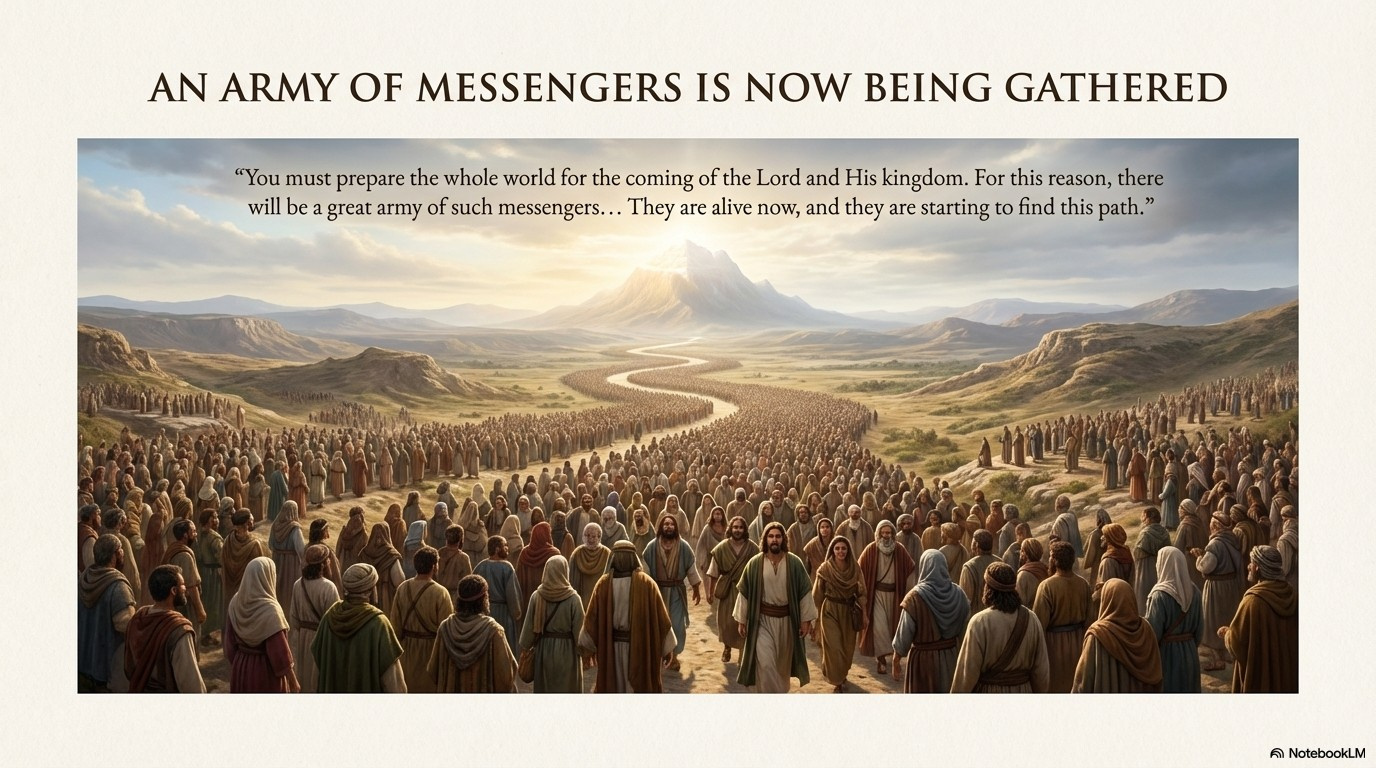
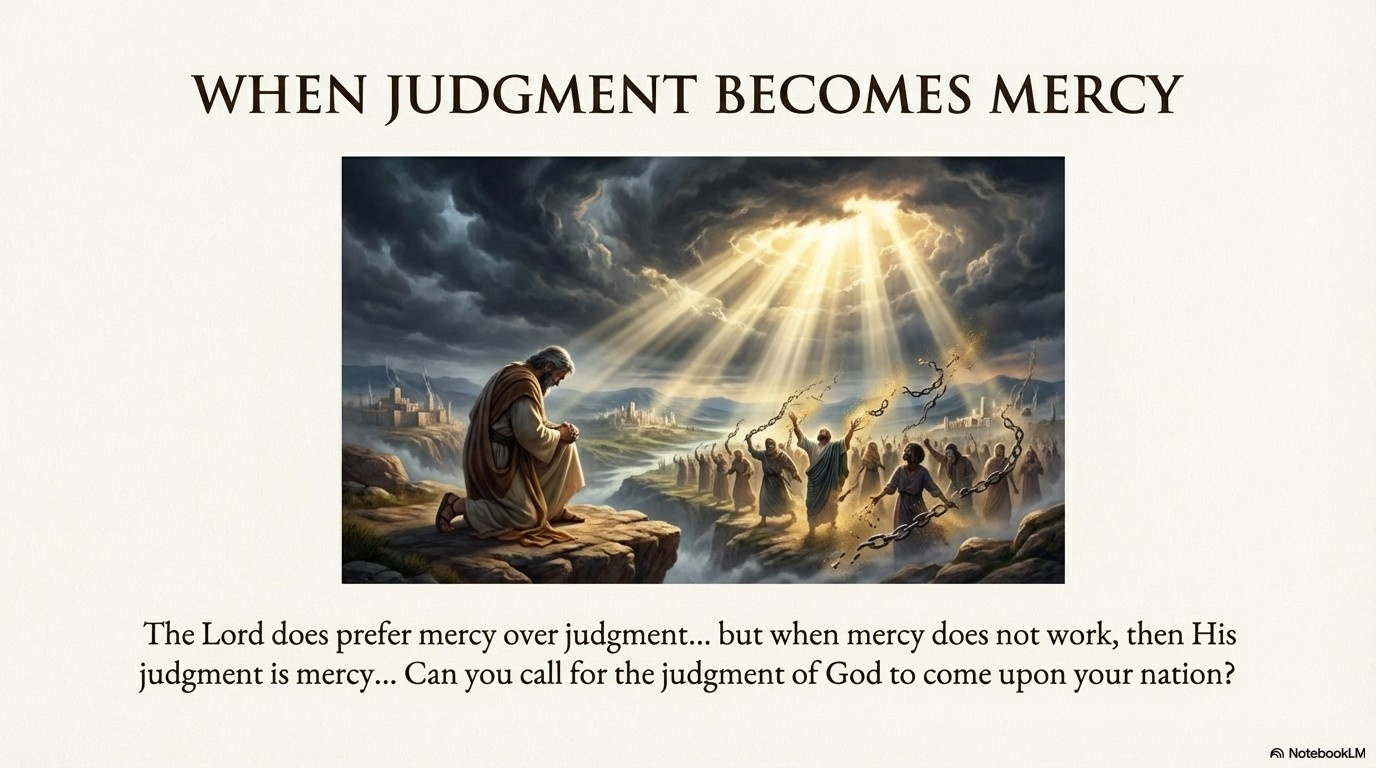
Elijah smiled. He then looked up as if he was asking what to do with me, or how to handle this question. After a pause, he began his answer: “Not everything about my life is a good model for the last-day ministry. These are still good lessons because some of the things that caused me to stumble will be a threat to the last-day ministry. One of these is the way I gave in to depression or arrogance when I began to think that I was the only one with truth or who was faithful to the Lord. These are still the primary traps that capture those who walk in great power. “Keeping this in mind, I was a model of the most powerful ministry that will ever walk the earth, the ministry that is being raised up at the end of this age. I had to confront the evil Jezebel who had taken over our nation and all of her false prophets and religions. The same spirit is taking over much of the world today and especially your nation. This evil is manifesting in your government just as Jezebel used Ahab. This is an ultimate evil, and those who are the Lord’s in this time will have to stand up to it, just as the Baptist also did as a type. There is much for you to learn about this, to do it without being rebellious, but nevertheless, disarming the powers of this age. This is given for the last-day ministry to do. “Next, I raised up many other prophets for the times. I also gave special attention to the one who was called to replace me, to do even more than I did and walk in more power than I did, Elisha. You must do the same. “The next task may be the most difficult of all. You must pray for the judgments of God to come upon your nations when they are needed, just as I did. “To do all of these things, you must always keep the interests of God above the interests of men. The Lord does prefer mercy over judgment, as we all should, but when mercy does not work, then His judgment is mercy. You must understand this, because to be His prophet in these times you must be in agreement with Him and His purposes at all times, even when it is time for judgment. “Can you call for the judgment of God to come upon your nation? The whole world is about to experience the kinds of judgments that came upon Egypt, and for the same purpose—to set God’s people free. The time for judgment is at hand, and this will begin with His own household. Can you be in agreement with Him for this?” Then Elijah paused and seemed to be gauging our reaction to this before he continued. I was also watching William, who seemed to grasp it all. “All of this you must do, but you also have the higher purpose. The Baptist had a higher purpose than I did because he was to point to the Lamb of God and compel people to follow Him. You have an even greater purpose than this. You must follow Him yourself. You must abide in Him. You must become like Him, and you must do the works that He did, while pointing to Him.” “Any one of these things would be more than enough for any person,” William remarked. “This is true,” Elijah admitted. “That is why those who will do these things are a great company. I was almost alone, as was the Baptist, but we were standing before a single, small nation. You must prepare the whole world for the coming of the Lord and His kingdom. For this reason, there will be a great army of such messengers.” “Will they all go to the mountain on this path?” William asked.

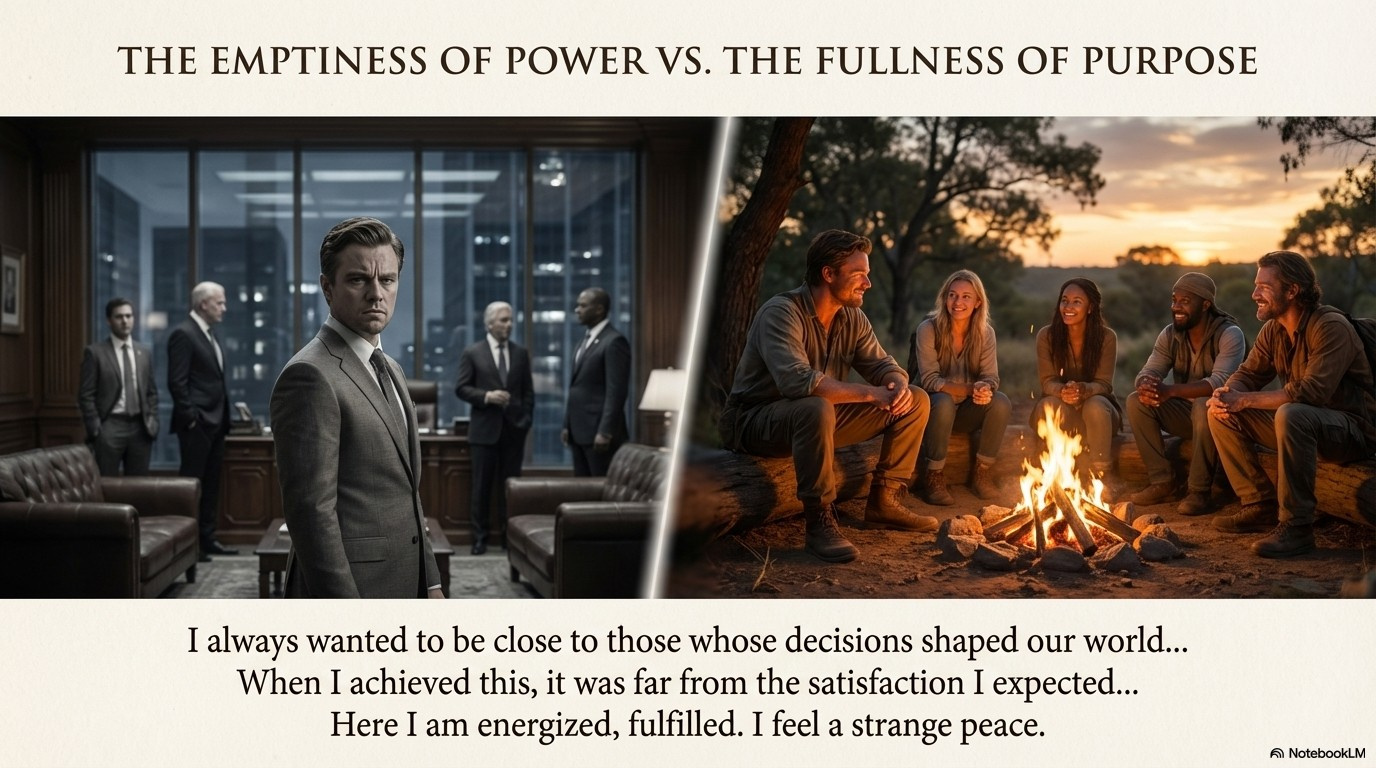
“They must all go to the mountain by this path,” Elijah acknowledged. “There are not many of us on this path now. Are there many more coming after us?” William continued. “There have not been many to walk this path yet, even throughout the church age, but there have been some on it at all times. More are coming. There will soon be more on this path than have ever walked it throughout the church age. Everyone who makes it to the mountain will go back and get others. There is a mighty army now being gathered. “Every one of these is a messenger. They are being prepared to shake cities and nations with the power of the message they will be given. In time, they will capture the attention of the entire earth, and everyone on earth will marvel at them. These will be ‘the mighty ones’ that Enoch prophesied would come. They are alive now, and they are starting to find this path,” Elijah concluded, and walked away. William and I sat for a time reflecting on what we had just been told. Finally William spoke: “I always wanted to be close to those whose decisions shaped our world. I built my life around that desire. When I achieved this, it was far from the satisfaction I expected. I now see that I was with the wrong people, because the power was never linked to a transcendent cause. Now I have that cause, and I can see how this little band we’re with could impact the world more than any congress or president. They may not look like much now, but these really are the great ones, aren’t they?” “I’m still learning about them too,” I said. “There could be prophets in this little group that eclipse anything that the prophets of old did, even Elijah. There could be last-day apostles here who transcend anything that has ever been accomplished to prepare the way for the King. What happened in the first century was the seed, but we are coming to the time of the harvest. We may have in our company some of the greatest men and women of God to ever walk the earth. “It is interesting that it was always your desire to be around world changers. You were able to do this in the natural, and now you’re about to do it with the spiritual. I think we are going to find this to be common here—the things we do in the natural reflect our spiritual calling,” I said. “Seeing Elijah is far more than I would have ever expected,” William replied. “Now I am being allowed to foresee what is about to be released on the earth. I already see that there could be some right here who eclipse what Elijah did. I feel more privileged to be here than in the most important offices of the greatest earthly leaders. Following Christ has already been more wonderful than I ever dreamed, and I’m just starting out. “Being in those earthly centers of power always left me feeling agitated and empty. I could not understand this until now. On this path with these simple ones, I feel a greatness I never felt with the earthly great. Here I am energized, fulfilled. I feel a strange peace. I have been greatly blessed by the Lord to now meet and travel with the truly great, those who are with us here. “Now, I don’t mean to be critical, but I need to know how the expression of Christianity here could be so different than what I experienced on the ship? With them, I felt more like I did with the worldly than I do here with these.”
“I don’t mean to be critical either, but I think leadership is a key to understanding this. The greatest leaders here will be the greatest followers of Christ. It all comes down to who we’re following, the King or our own ambitions, which is still ambition, even if we’re doing it in the name of the King.”